Showing posts with label Immigration and Customs Enforcement (ICE). Show all posts

Monday, March 5, 2012

Seize and Send v. Investigate and Indict: Focusing on Cultural Heritage Criminal Investigations and Prosecutions

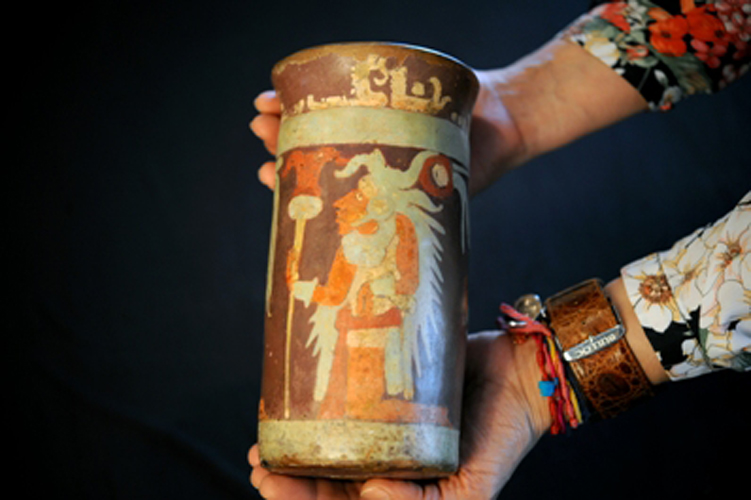
ICE and CBP return an illegally
imported artifact to Guatemala.
Courtesy ICE.
Immigration and Customs Enforcement (ICE) and Customs and Border Protection (CBP) held a press conference on February 24 to publicly display the return of pre-Columbian objects to the Guatemalan foreign minister. The objects were recovered both in Houston, Texas in 2009 and from an auction house in Massachusetts in 2011. WJZ television in Baltimore reported that “[n]o arrests in the smuggling cases have been made, although federal agents say investigations are ongoing.”

Authorities are to be lauded for detecting and seizing illegally imported archaeological objects. But the claim that federal officials are continuing their investigation remains to be seen. That is because the primary evidence of possible smuggling has now been returned to Guatemala. The artifacts are no longer preserved for criminal analysis, they are not kept in safekeeping for use in court proceedings, and they are not available for inspection by potential criminal defendants who have a constitutional right to view the government’s evidence in a criminal case.

There appears to be no US Attorney involvement in this case, which is a sign that the matter likely is not being reviewed for possible criminal charges. And Homeland Security does not mention in its official press release that it is pursuing a criminal investigation. At best the agency cautions that “[t]hose involved in the illicit trafficking of cultural property, art and antiquities can face prison terms of up to 20 years, fines and possible restitution to purchasers of the items.“

Those who follow cultural property cases closely are aware that Homeland Security generally implements a seize and send policy with regard to cultural artifacts. While the agency boasts in its latest press statement and elsewhere that “[s]ince 2007, HSI [Homeland Security Investigations] has returned more than 2,500 artifacts to 23 countries …”it is silent about successful cultural property prosecutions. Such prosecutions are rare.

The Cultural Property, Art and Antiquities Investigations Program is carried out by HSI. The program describes its mission on ICE’s web site: “Returning a nation’s looted cultural heritage or stolen artwork, promotes goodwill with foreign governments and citizens, while significantly protecting the world’s cultural heritage and knowledge of past civilizations.” The emphasis is on sending cultural objects to home countries, not on developing cases for criminal prosecution.

It could very well be that the lack of financial or human resources prevents the development of cultural property smuggling cases. It could be too that politics affects agency decision making. Indeed, it may be noteworthy that on the same day of the repatriation of artifacts to Guatemala, Homeland Security Secretary Janet Napolitano announced that she would be traveling to Guatemala City and other Latin American destinations between February 27 and 29. Perhaps prosecutors are rejecting these cases for review. Whatever issue prevents ICE from doing its job to investigate and prepare cases for presentation to a federal grand jury and subsequent criminal prosecution must be resolved.

ICE Director John Morton is right to note “the exceptional investigative work HSI is doing to stop the pilfering and illicit trading of precious art and antiquities from around the world.” ICE has talented investigators. But more must be done to bring the talents of these federal agents to the next level so that their cases serve to provide a meaningful deterrent to archaeological smuggling. Investigators must be permitted to conclude their cases by submitting them to receptive US Attorneys for review and possible indictment. Cases concluded through seizure, forfeiture, and repatriation alone do not have a similar impact on criminal activity.

Sources:
Homeland Security press releases
http://www.ice.gov/news/releases/1202/120224washingtondc.htm
http://www.dhs.gov/ynews/releases/20120224-statement-on-napolitano-trip-to-central-america.shtm

WJV TV
http://baltimore.cbslocal.com/2012/02/24/stolen-ancient-mayan-artifacts-being-returned-to-guatemala/

CONTACT: www.culturalheritagelawyer.com

Tuesday, January 24, 2012

Lewis Defense Lawyers File Motion to Dismiss in US v. Khouli et al.

Even before trial begins and testimony is heard, the case against Joseph Lewis, II must be dismissed because the government cannot prove its case.  That is what defense lawyers argue in a motion filed today in the US District Court, Eastern District of New York in the case of US v. Khouli et al.  The lengthy memorandum of law contends that the government lacks sufficient evidence to proceed to trial based on the information supplied in discovery materials.

Evidence in US v. Khouli et al.
Source: ICE
A federal grand jury indicted Joseph Lewis, Moussa Khouli, and two others in July 2011 alleging, in part, that Lewis illicitly bought Egyptian antiquities that were illegally imported into the United States through Dubai. The indictment also alleges that the four conspired together and with unidentified “others” in a smuggling operation.  (A defendant is presumed innocent unless the government proves guilt beyond a reasonable doubt).  The objects involved in the case include a Greco-Roman style Egyptian sarcophagus and a three-part nesting coffin set. See here for background.

Despite being accused of wrongdoing related to the import of ancient Egyptian antiquities, defense lawyers contend that Lewis was not involved with the importation process at all.  In fact, the only co-defendant Lewis had contact with at any time was Moussa Khouli, and that contact was after any object was imported into the United States, according to attorneys.  This argument is buoyed by defense lawyers' statements asserting that Lewis had neither sent nor received any emails discussing importation of cultural artifacts with Khouli.  Therefore, Lewis' lawyers argue that Lewis had no participation in the import process. 

Lewis had every reason and motive to want the import process to be legal, the defense attorneys claim.  Email exchanges between Khouli and Lewis never hinted at any illegal activity, they say.  Lewis, in fact, never had any idea that any pieces were stolen, particularly after having been informed by Khouli in writing at least seven times that the Egyptian pieces were part of Khouli’s father’s collection in Israel during the 1960’s.

Moreover, defense counsel contends that prosecutors cannot prove that the items in questions were stolen.  They highlight that there has been no assertion by Egypt that the items are in fact stolen.  And if the prosecution argues that the incomplete provenance of the artifacts should have informed Lewis that the objects may have been stolen, defense lawyers cite journal articles to show that lack of provenance is common in the antiquities market and does not demonstrate that a cultural object is in fact stolen.

 Lewis’ lawyers conclude that the lack of evidence cannot sustain a conviction, warranting a dismissal of the government's criminal case.

Contact: www.culturalheritagelawyer.com

Wednesday, January 18, 2012

Federal Attorneys File Appellate Brief in Baltimore Coin Case


Attorneys for the United States have filed their brief in the matter of Ancient Coin Collectors Guild v. U.S. Customs and Border Protection; U.S. Department of State; Assistant Secretary of State, Educational and Cultural Affairs. The United States’ brief rejects the Ancient Coin Collectors Guild’s (ACCG) interpretation and application of the Cultural Property Act (CPIA), writing that the ACCG “fundamentally misunderstands the CPIA’s statutory scheme.”

Last September the ACCG appealed to the Fourth Circuit Court after a federal district court judge dismissed its test case. The group initially filed the lawsuit hoping to challenge cultural heritage import protections enacted under the Cultural Property Implementation Act (CPIA). According to the government’s brief, “[o]n April 15, 2009, [the ACCG] transported [Chinese and Cypriot] coins from London to Baltimore with the intention of testing the validity of existing import restrictions. The invoice accompanying the coins identified each by type and indicated that each was minted in China or Cyprus, but provided no indication of when the coins first arrived in London (or any other information regarding the history of the coins).” Customs seized the ancient coins. The district court then struck down the ACCG’s challenge to the seizure after concluding that the group failed to make out a sufficient case to show that the government acted outside its legal authority.

The ACCG filed an appellate brief with the federal circuit court on October 31, 2011, arguing that the enactment and application of the import controls by the State Department and/or Customs and Border Protection (CPB) was unlawful and should be reviewed under the standards of the Administrative Procedures Act (APA).  (The APA is the law that instructs federal agencies about how they must establish administrative regulations.  The Act also outlines the procedures by which administrative decisions are reviewed by the courts.The ACCG also argued in its brief that the United States government could not issue cultural property import protections on certain ancient coins since China allegedly did not request the import restrictions.  The group further explained that the CPIA’s import controls require federal officials to prove an ancient coin’s find spot before it can be seized. The United States’appellate brief, filed on January 13, 2012, counters these claims.

Attorneys for the United States contend in their brief that its agencies followed the rules while the ACCG did not follow the process.  The government's lawyers write that the ACCG should have followed the forfeiture process established by Congress.  Instead, the ACCG filed a lawsuit. “The CPIA’s provisions regarding seizure and forfeiture, in concert with the pre-existing statutory scheme addressing forfeiture proceedings, set forth a process by which claimants may contest a threatened forfeiture,” the government argues. Federal lawyers state that the “APA authorizes judicial review of agency action only ‘for which there is no other adequate remedy in a court.’ The circumstances in which extra-statutory review is available are similarly limited.  Here, however, Congress has expressly provided for challenges to the seizure and forfeiture of materials under the CPIA through the established mechanism of administrative or judicial forfeiture proceedings.”

At the time of the attempted import of the coins in Baltimore, lawyers for the United States say that “Customs provided [the ACCG] with the opportunity to present a certification of lawful export or other evidence establishing a right to entry . . . . [but the ACCG] disclaimed any ability to present such evidence.  On July 20, 2009, Customs seized the coins, and explained that – in light of [the ACCG’s] representations – the items would be subject to summary forfeiture absent a request by plaintiff for judicial proceedings.”  Government lawyers say that even though the ACCG requested a judicial forfeiture proceeding in September 2009, “Plaintiff [ACCG] did not await the commencement of judicial forfeiture proceedings by the U.S. Attorney’s Office.  Rather, on February 11, 2010 – five months after requesting such proceedings – plaintiff commenced this suit to challenge the seizure of its ancient Chinese and Cypriot coins.”  The government observes that “Plaintiff [ACCG] has invoked those procedures, but they have not occurred as this litigation has been ongoing. Plaintiff does not explain why its arguments should not be considered in the forum designated by Congress.”

Had the ACCG challenged the seizure of the coins through the congressionally prescribed forfeiture proceeding, it would have confronted a defined standard of proof requiring the ACCG to show that the coins were legal to import. The government’s brief describes the standard of proof that applies in a forfeiture proceeding: “the government must establish that the seized property is material that has been designated as restricted under [the CPIA].  After this initial showing, the burden shifts to the claimant [ACCG] to show that the property is not subject to forfeiture, or to establish an applicable affirmative defense.”

The United States rebukes the ACCG for short-circuiting the judicial forfeiture proceeding, avoiding its burden of proof, and claiming that the government acted beyond its authority (i.e. ultra vires).  The government contends that the “Plaintiff [ACCG] cannot properly circumvent the statutory scheme established by Congress by asking a district court to review this seizure under the APA and under the rubric of ultra vires review and . . . to further confound Congress’s intent by asking the court to disregard the burden of proof established by the CPIA.”

Attorneys for the United States further maintain that the ACCG has confused the meaning and requirements of the CPIA. They point out that “[t]o import the coins into the United States, plaintiff [ACCG] needed only to show that the coins had left Cyprus or China before the effective dates of the relevant Designated Lists.  Plaintiff declined to offer any declaration to that effect, claiming that it could not offer the evidence required by the statute because it did not know whether the coins had been ‘first found in the ground’ of either China or Cyprus. But the CPIA quite plainly does not require plaintiff to know where the coins were ‘first found in the ground’; all that was required was information as to the whereabouts of the Cypriot coins as of July 16, 2007 and of the Chinese coins as of January 16, 2009.”

The government's lawyers pointedly draw attention to the fact that the President exercises his foreign affairs powers when acting pursuant to the CPIA. The attorneys highlight that “[t]he provisions of the CPIA confirm that Congress recognized that these judgments are imbued with foreign policy concerns.” They describe how “[t]he CPIA provides the President with broad power to apply import restrictions pursuant to MOUs he enters into with foreign States in furtherance of the United States’s obligations under the Convention on Cultural Property and with the goal of ‘promoting U.S. leadership[] in the preservation of cultural treasures.’” The attorneys point out that “Congress recognized that allowing illicitly excavated and trafficked artifacts to enter into the United States, thereby permitting a market in such goods, threatened our relationships with other nations, and that this legislation was thus “‘important to our foreign relations.’” They also explain that “the issues raised by the import of cultural goods are ‘distinct from the normal concerns of the reciprocal trade agreements program or U.S. trade law.’”

The review of American foreign policy decisions by the courts essentially would be improper, suggests the brief, particularly where foreign policy considerations have other avenues of oversight.  “Rather than involve the courts in an inquiry into the conduct of foreign affairs, Congress provided for political review by requiring the CPAC [Cultural Property Advisory Committee] to share its reports with Congress, and requiring the President to report actions taken to Congress,” says the government’s brief.

Federal lawyers contend that even if there is court review of the government’s implementation of import restrictions enacted under the CPIA, government agencies acted properly. Their brief asserts that “[i]f the Court concludes that some form of judicial review is nevertheless appropriate in these proceedings, it should affirm the district court’s conclusion that plaintiff has not stated a viable claim.”

In support of this argument, attorneys for the United States point out that the ACCG’s “primary contention is that its 22 ancient Cypriot and Chinese coins were unlawfully seized based on their ‘type.’ Plaintiff urges that, although the coins appear on the Designated Lists of restricted materials published by Customs, the coins must be allowed entry to the United States unless the government can prove, on a coin by coin basis, that each was first unearthed in Cyprus or China. The district court correctly concluded that plaintiff’s proposed scheme lacks any basis in the statute.”  Therefore, the federal lawyers maintain that “[t]he Assistant Secretary [of State] exercised her judgment and discretion under the CPIA in determining that certain types of ancient Cypriot and Chinese coins qualify as the ‘archaeological material of the State Party’ and applying import restrictions to them. As the district court concluded, plaintiff’s approach can not (sic) be reconciled with the plain terms of the Act, is unworkable, and ‘would undermine the core purpose of the CPIA.’”

Attorneys for the United States also address in their brief the ACCG’s request for information.  “[The ACCG’s] amended complaint alleged that ‘China never formally requested import restrictions on coins,’ and urged that the government’s restrictions on Chinese coins should thus be deemed invalid. This is unsurprising, since – as the government has previously noted – China’s request did, in fact, address ancient Chinese coins, as noted in the public summary of the request that is posted on the State Department’s website.”  That said, federal lawyers declare that “the district court correctly rejected plaintiff’s request for discovery with regard to the precise contents of China’s diplomatic note requesting that the United States impose import restrictions under Article 9 of the Convention on Cultural Property. The United States has met all of its statutory obligations, and is not required to make such information public."

Finally, the government addresses the constitutional issues raised by the ACCG: “Plaintiff asserts that the import restrictions at issue 'impinge on collectors’ access to information materials' in a 'grossly overbroad' manner and are thus 'constitutionally suspect under both the First and Fifth Amendments.' Contrary to plaintiff’s characterization, the CPIA does not ban the sale of ancient coins or prevent individuals from accessing the information they offer. Rather, the [CPIA] allows the importation of the designated coins when particular requirements, which are designed to prevent the illicit trafficking of ancient artifacts that are under threat from pillage or looting, are satisfied. It is contrary to no recognized constitutional interest."

[Note: All quotes are from the government's appellate brief.  Citations in the original have been omitted.]

Contact: www.culturalheritagelawyer.com

Thursday, January 5, 2012

Court Forfeits Cristo Portacroce After Italy Does Not File A Claim

The forfeited Cristo Portacroce.
Courtesy ICE
The United States District Court for the Northern District of Florida has ordered the forfeiture of the painting, the Cristo Portacroce Trascinato Da Un Manigoldo.  The court issued the default judgment once the previous possessors, Italy and its Brera Art Gallery, failed to make a claim for the return of the artwork.

The court's ruling was brief:  "Upon Application of the Plaintiff(s) in the above styled cause and having examined the records and there appearing to be no responsive pleadings filed by the defendant(s), default is hereby entered against the Italian Republic, Ministry of Culture, and the Pinacoteca di Brera, on January 3, 2012."

The painting will likely be handed over to the heirs of Federico Gentili di Giuseppe, who filed a claim on December 14, 2011 arguing that they were the lawful owners.  Prosecutors submitted information to the court that the painting was taken from the family by the Nazis during World War II.  Click here for details.

Federal officials seized the Cristo Portacroce in November 2011, which the Mary Brogan Museum of Art and Science in Florida had on loan.  See here for background.

Court papers filed by government lawyers show that the Italian's were aware that the painting's ownership was in dispute.  But the records do not explain why the Italy-Brogan loan agreement did not contemplate legal protection from seizure under the federal law known as Immunity from Seizure Under Judicial Process of Cultural Objects Imported for Temporary Exhibition or Display.

Tuesday, December 6, 2011

MoU Extended With Bolivia - US Customs Issues Final Rule

Tamucumira Mask.
One of the Bolivian objects subject to
CPIA import regulations.
Photo courtesy US State Dept.
The US government has extended import protections over archaeological and ethnological objects from Bolivia. The two governments entered into a bilateral agreement  in 2001 pursuant to the Cultural Property Implementation Act (CPIA), which gives force to the 1970 UNESCO Convention (the Convention on the Means of Prohibiting and Preventing the Illicit Import, Export, and transfer of Ownership of Cultural Property). Import restrictions under the agreement last five years and may be renewed each period.

Bolivia received emergency protection under the CPIA in 1989.  A bilateral agreement, or Memorandum of Understanding (MoU), was finalized in 2001, and the US government renewed that MoU in 2006.  The latest renewal occurred earlier this year.  The Federal Register reports:

"On August 26, 2011, after reviewing the findings and recommendations of the Cultural Property Advisory Committee, the Acting Assistant Secretary for Educational and Cultural Affairs, United States Department of State, concluding that the cultural heritage of Bolivia continues to be in jeopardy from pillage of certain archaeological and ethnological materials, made the necessary determination to extend the import restrictions for an additional five years. On November 10, 2011, diplomatic notes were exchanged reflecting the extension of those restrictions for an additional five-year period."

On December 1, 2011, US Customs and Border Protection published its final rule describing the specific import regulations.  The rule may be found here.

Thanks go to Gary Nurkin for news of the rule's publication.

Thursday, December 1, 2011

US-Greece MoU Produces Final Cultural Property Import Protection Rule

United States Customs and Border Protection today issued the final administrative rule covering import restrictions covering archaeological and ethnological material from Greece. The rule follows the July 17, 2011 adoption of a memorandum of understanding (MoU) between the United States and Greece under the Cultural Property Implementation Act in accord with the 1970 UNESCO Convention on the Means of Prohibiting and Preventing the Illicit Import, Export, and Transfer of Ownership of Cultural Property. The MoU entered into force on November 21, 2011 and can be found here.

Greek mosaic.
Source: Bijan.  CC.
Import protections are now in place on Greek archaeological and ethnological cultural items dating from around 20,000 B.C. through the 15th century A.D. These restrictions last for five years and were instituted in order to "control illegal trafficking of such articles in international commerce" and to protect "endangered cultural property," according to the rule.

Ancient objects subject to seizure at the American border include those made of stone, metal, ceramic, bone, ivory, glass, faience, textile, papyrus, paint, mosaic, wood, glass, and parchment. The import restrictions cover sculptures, sarcophagi, reliefs, furniture, vessels, tools, weapons and armor, coins, beads, pottery, musical instruments, documents, paintings, floor mosaics, and more.

Lawful entries of these specified cultural objects are permitted in certain cases. For example, a valid export permit from Greek authorities would allow an archaeological or ethnological cultural object to enter the US border.

The Federal Register has published the rule at 19 CFR Part 12.  Click here for the full text.

Wednesday, November 30, 2011

Change of Venue Motion Filed in US v. Khouli et al. Previews Possible Defenses in Alleged Antiquities Trafficking Case


Federal courthouse in Brooklyn, NY.
Photo by Jim Henderson.  CC
The latest pleading filed by Salem Alshdaifat’s attorney in the case of US v. Khouli et al. asks for a change of venue. The defense argues that personal and financial hardships faced by Alshdaifat, a Michigan resident, urge a transfer of the case from the federal district court in New York to Detroit.

The motion provides a possible preview into some of the defenses that may be available in the case, including:
  • a characterization of the charged conduct as “regulatory-based criminal charges,”
  • a claim that the objects that are the subject of the multi-count indictment are neither stolen nor contraband, and
  •  an argument that Alshdaifat was a middle man who did not possess criminal intent.
A federal grand jury charged Alshdaifat in May 2011 with conspiracy to smuggle, alleging that he directed Mousa Khouli to wire $20,000 to Ayman Ramadan’s UAE bank account and that Alshdaifat received an airway bill from Ramadan showing that “wooden panels” were being shipped by Ramadan’s company in the United Arab Emirates to JFK airport in New York.  Moreover, Alshdaifat is charged with money laundering conspiracy.  He is also charged with smuggling goods into the country as well as fraudulent importation and transportation of goods.  The indictment describes the goods as an Egyptian inner coffin, Egyptian funerary boats and limestone figures, and a portion of an outer lid of a nesting Egyptian coffin set.  (A grand jury indictment is a mechanism that initiates a criminal case; it is not a finding of guilt.)

Writing in support of the motion for change of venue, Alshdaifat’s attorney previews the possible defenses in the case.  The following are excerpts from the Memorandum of Law dated November 21, 2011:
  • “The facts surrounding these charged criminal violations of the Customs laws arise out of the importation of rare Egyptian antiquities, including a three-piece set of sarcophagi and other funerary objects. These artifacts were allegedly shipped to the United States in several packages, variously by international air mail and by private air and sea carriers. The government does not claim that the Egyptian artifacts were stolen or were otherwise contraband when they entered the country. Instead, the government's charges rest on a theory that the alleged conspirators willfully falsely or vaguely declared these artifacts in entry documents into the United States because the importer purportedly had insufficient or incomplete documents of origin for the objects and this might have caused them to be detained at a United States port-of-entry if detected.” (emphasis in the original)
  •  “Mr. Alshdaifat was neither the U.S. importer nor the foreign exporter of the subject Egyptian artifacts. Based on the government's own claims, he is alleged to have been the “finder” or middleman that put the alleged foreign source of the artifacts (defendant [Ayman] Ramadan) in contact with the U.S. importer, or interested antiquities dealer (defendant [Mousa] Khouli). Despite being charged with a role that essentially ended prior to the importation process, Mr. Alshdaifat is charged with his co-defendants for knowingly participating in making false or intentionally incomplete statements on shipping labels on various shipments of these Egyptian antiquities.  The government's claims against Mr. Alshdaifat, therefore, rely on findings that he knew and intentionally joined a conspiracy to falsely declare the Egyptian artifacts in their shipment to the United States after his role in being a broker to the transactions was already completed.” (emphasis in the original)
  •  “In the Egyptian sarcophagi transactions, however, Mr. Alshdaifat only had a broker's interest and did not deal in the artifacts himself. Somehow, however, he now finds himself charged together with the principals of those transactions for allegedly violating technical Customs laws in the mailing and shipping of the merchandise, a process in which he did not participate.”
  • “The government’s position in support of criminal liability on the charged air mail shipments is based largely on the claim that Mr. Alshdaifat's co-defendants put these pieces in international mail or on an airplane as air cargo without completing more formal U.S. Customs paperwork with the specific intent to avoid Customs’ detection of these shipments and break U.S. Customs' law.  No lay witnesses exist to testify as to whether a defendant's act of putting these parcels in the mail or on an airplane constituted an intentional and clandestine conspiratorial effort to get the charged, legal merchandise into the United States.” (emphasis in the original and footnote omitted)
  •  “In any event, Mr. Alshdaifat is not even implicated in the government's discovery with doing anything – in New York or elsewhere – to assist in the importation of the merchandise. He is charged with putting the alleged source of the Egyptian coffins and artifacts (defendant [Ayman] Ramadan) in contact with the New York antiquities dealer who purchased them (defendant [Mousa] Khouli). The government must concede that Mr. Alshdaifat was neither the importer nor exporter of the charged shipments, and therefore had no role in the actual shipment of the merchandise, i.e., the packaging, labeling and placing of the merchandise in international mail.  As such, he never had any contacts with New York.”
  •  “The government does not charge that the Egyptian coffins and funerary objects were stolen property. The objects imported, therefore, are not contraband or unlawful to possess in the United States. The government's claims in this Indictment rest instead on the precarious theory that the method in which the artifacts were shipped into the United States was intentionally fraudulent even though the goods themselves were not banned or prohibited from entry. Indeed, the government does not even claim that the method of importation was intentionally fraudulent to avoid import duties, since antiquities are excluded from any import tax.” (emphasis in the original)
The defense contends that the government’s conduct materially affected Alshdaifat’s business.  Alshdaifat writes in a Declaration to the court dated November 21, 2011 that he started dealing in ancient coins in Canada, selling them primarily over the internet and at international trade shows.  He describes himself as a specialist in ancient Judean coins who gained admission to many coin auction houses and membership associations.  Alshdaifat adds that he was the moderator of the “Judean ancient coin section for the largest numismatic worldwide web community.”  Defense counsel’s Memorandum of Law explains:

“Mr. Alshdaifat's circumstances are particularly extraordinary. These include the fact that from his initial arrest, the government stacked the deck against him, making it untenable for him to get his fair day in court. On July 13, 2011, the government arrested Mr. Alshdaifat in his Michigan home and confiscated his entire business inventory of ancient coins, thereby effectively shutting his business down.  It did so despite the fact that the criminal charges in the Indictment had nothing to do with Mr. Alshdaifat's coin business. Subsequently, the government returned his coins but not until his business suffered a crushing, and possibly, fatal blow. Mr. Alshdaifat's reputation as an honest coin dealer has been battered; more importantly, he has been removed or suspended from all of the auction houses where he sold his coins. His business is in dire shape.” (emphasis in the original)

Information supplied to the court describes the relationship between Alshdaifat and co-defendant Ayman Ramadan.  Court papers remark that “Mr. Alshdaifat has purchased ancient coins before from defendant Ramadan in the United Arab Emirates ("U.A.E.") and has sold coins to defendant Khouli in New York. 
 That is how he knew two of the other parties charged in this Indictment.”

Wednesday, November 9, 2011

PART II OF II: US Attorney Reveals Legal and Factual Claims in Forfeiture Lawsuit Against Cristo Portacroce – Case Reveals Italy’s Refusal to Turn Painting Over to Gentili di Giuseppe Family


Portrait of Girolamo Romano,
painter of the disputed artwork known as
Cristo Portacroce Trascinato Da Un Mangoldo.
In support of the warrant seizing Christ Carrying the Cross Dragged by a Rogue (Cristo Portacroce Trascinato Da Un Manigoldo) from The Mary Brogan Museum of Art and Science and in support of the civil complaint seeking forfeiture, the US Attorney for the Northern District of Florida supplies important details about the artwork’s asserted history.  Homeland Security Investigations (HSI) agent Phillip Reynolds describes facts in an affidavit submitted to the federal district court that permits the construction of the following timeline and details:

June 1914 - Art collector Federico Gentili di Giuseppe, Italian and of Jewish descent and living in Paris, purchased the Cristo Portacroce from the Crespi family collection. The 16th century painting by artist Girolamo Romano, was lawfully exported from Italy.

April 20, 1940 - Just before the Nazi invasion of France, Federico Gentili di Giuseppe died and left his estate to his son and daughter. They fled Paris without their possessions.

March 17, 1941 - The French Vichy government ordered the liquidation of the entire Gentili di Giuseppe estate.

April 23, 1941 - The Cristo Portacroce, and dozens of other paintings once in the Gentili di Giuseppe family’s possession, were auctioned. “Lemar” of Paris reportedly bought the Cristo Portacroce.

1994 - A Girolamo Romani catalog raisonné published by Alessandro Nova listed the Cristo Portacroce as having been owned by Federico Gentili di Giuseppe.

1997 – Descendants of Federico Gentili di Giuseppe sued the Louvre for the return of five paintings sold during the same auction as the Cristo Portacroce.

1998 - The Brera Art Gallery (Pinacoteca di Brera) took possession of the painting, although no details are provided regarding this transfer.

June 2, 1999 – a French court ordered custody of the five paintings at the Louvre to Federico Gentili di Giuseppe’s descendants, acknowledging that the 1941 auction was a “nullity” in that several painting were purchased by Nazis, including Luftwaffe chief Hermann Göring. The court also ordered the Louvre to pay 40,000 francs (approximately $8300).

After June 2, 1999 – The Art Institute of Chicago, the Boston Museum of Fine Arts, and the Art Museum of Princeton University all returned works of art to the Gentili di Giuseppe family heirs. Institutions in Berlin, Cologne, and Lyons did the same.

January 10, 2000 and March 14, 2000 – Lawyer Jean Pierre Sulzer twice contacted the the Brera Art Gallery by mail on behalf of Gentili di Giuseppe’s descendants, receiving no reply.

2001 – The Brera Art Gallery referred the restitution claims of the Gentili di Giuseppe heirs to the Italian Ministry of Culture, and attorneys for the family wrote a letter to the ministry on October 3, 2001 asking for the painting.

June 6, 2002 – The Commission for Art Recovery of the World Jewish Congress, a New York based group that seeks to restitute cultural property taken from Holocaust victims, wrote a letter to Italian President Silvio Berlusconi after the Ministry of Culture reportedly rejected the claims of the Gentili di Giuseppe family. The letter urged the president to reconsider Italy’s position.  (The contents of the letter suggest that the Brera made an earlier reply stating that it acquired the painting--and a second painting--in good faith.  The Brera's letter is not contained in court documents).

March 14, 2003 – The Italian Ministry of Culture responded to the Commission for Art Recovery’s intervention by saying that it carefully reviewed the matter in light of the Washington Principles and could not find that it could accommodate the request for repatriation. (See the Washington Principles here).

2006 – The Commission on Looted Art in Europe reportedly contacted the Italian government in an effort to have the Christo Portacroce returned.

March 18, 2011 – The Brogan placed the painting on display at its museum in Tallahassee, Florida.

November 4, 2011 – The loan contract between the Brera and the Brogan was due to terminate on November 6, and the painting was to be delivered to Italy.  Immigration and Customs Enforcement (ICE seized the painting on November 4, 2011 to prevent its return to Milan, and the US Attorney filed its in rem action against the artwork seeking its forfeiture.

The prosecution will seek to prove these alleged facts as it attempts to convince the federal district court that it has the evidence to forfeit the Cristo Portacroce.  Time will tell if any party steps forward to contest the claim.

See Part I for a discussion of the US government's asserted legal claims in this case.

Tuesday, November 8, 2011

PART I OF II: US Attorney Reveals Legal and Factual Claims in Forfeiture Lawsuit Against Cristo Portacroce – Argues That Painting Loaned to The Brogan by The Brera Was Stolen, Smuggled, and War Material


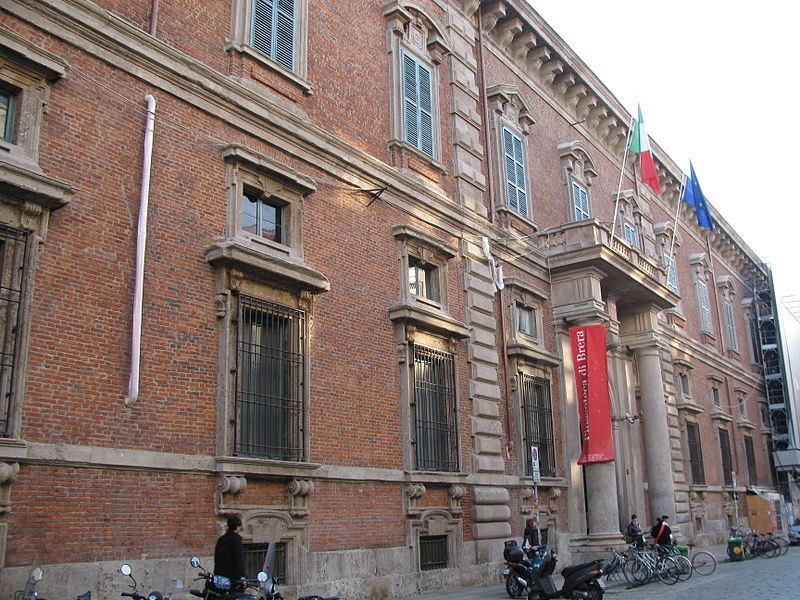
"The Brera,"
which once possessed the Romano painting
seized by ICE in Florida on November 4, 2011.
Author: Masi27185. Creative Commons License
Immigration and Customs Enforcement’s (ICE) Homeland Security Investigations (HSI) seized the painting known as Christ Carrying the Cross Dragged by a Rogue pursuant to a court authorized warrant on Friday, November 4, 2011. Judicial records reveal that federal officials chose to seize the painting at that time because the artwork, which was on loan to and openly displayed at The Mary Brogan Museum of Art and Science, was about to be returned to the Brera Art Gallery (Pinacoteca di Brera) in Milan, Italy. The Brera originally possessed and loaned the artwork, painted by Girolamo Romano around 1543.

The US Attorney’s Office for the Northern District of Florida filed a civil forfeiture action in federal district court in Tallahassee the same day as the seizure. Seizure permits the government to take possession of the painting, but a forfeiture order issued by the court would allow the government to gain title of the painting. That is why the US Attorney’s Office filed an in rem (against the thing) lawsuit, naming the artwork as the defendant. The case is captioned and docketed as United States of America v. Painting Known as Cristo Portacroce Trascinato Da Un Mangoldo, 4:11-cv-00571-RH-WCS.

Federal prosecutors argue in their civil complaint that forfeiture of the painting is proper under multiple legal theories. They cite the typical ones under the criminal statutes (Title 18 of the United States Code) and the customs statutes (Title 19 of the United States Code). But the government also makes a claim under Title 22, the foreign relations section.

First, prosecutors allege that the painting was smuggled pursuant to 18 USC § 545 and therefore must be forfeited under the terms of this criminal statute.

They also say that the artwork must be forfeited because it was illegally imported in contravention of the customs law at 19 USC § 1595a(c)(1)(A) since the painting was “stolen, smuggled, or clandestinely imported or introduced” into the United States.

Next, federal attorneys claim that the painting was about to be exported in violation of 19 USC § 1595a(d), a customs law requiring that the painting “shall be seized and forfeited to the United States” because its export would be “contrary to law.”

Federal lawyers also make a claim under the Illegal Exportation of War Materials statute at 22 USC § 401(a), saying that it mandates forfeiture of the painting: “Whenever an attempt is made to export or ship from or take out of the United States any arms or munitions of war or other articles in violation of law, or whenever it is known or there shall be probable cause to believe that any arms or munitions of war or other articles are intended to be or are being or have been exported or removed from the United States in violation of law” then the article may be seized and shall be forfeited.” (Emphasis added by the author).

Finally, the government makes the claim that the painting was stolen under 18 USC § 2314, the National Stolen Property Act, which criminalizes conduct whereby a person “transports, transmits, or transfers in interstate or foreign commerce any goods, wares, merchandise, securities or money, of the value of $5,000 or more, knowing the same to have been stolen, converted or taken by fraud.”

The court will decide if prosecutors possess the evidence to prove their case.  To date, the information prosecutors possess appears considerable. That material is discussed in Part II.

Friday, November 4, 2011

ICE Seizes Stolen Art From Florida's Brogan Museum - Said To Be Taken During WWII

ICE seizes Romano painting said to be stolen by the Nazis.  Photo courtesy of ICE
Immigration and Customs Enforcement (ICE) officials in Tallahassee, Florida yesterday served a seizure warrant on "Christ Carrying the Cross Dragged by a Rascal."  The painting had been held at the Mary Brogan Museum of Art and Science at the request of the US Attorney's office, northern district of Florida, while prosecutors determined whether the painting by Girolamo Romano’s was unlawfully taken from a Jewish family during World War II.  Now the artwork is now in federal custody.

Who will have final title and possession of the artwork ultimately will be determined by a federal district court judge.

[UPDATE: November 9, 2011 - Read more details here.]

Find the complete press release describing the seizure and issued by ICE here.  Also, listen to Chucha Barber, the Brogan Museum’s chief executive officer, who provides a short audio sketch of the ownership claims to the painting on PRI's The World.

Thanks go to Gary Nurkin for alerting me to this news.

Tuesday, October 4, 2011

Stolen Art Repatriated to Poland Following Default Judgment in U.S. v. One Julian Falat Painting Entitled “Off to the Hunt” and One Julian Falat Painting Entitled “The Hunt”

U.S. Immigration Customs and Enforcement’s (ICE) Homeland Security Investigations (HSI) and the U.S. Attorney’s Office for the Southern District of New York repatriated two Julian Falat paintings on September 22, transferring them to President BronisÅ‚aw Komorowski of Poland in a ceremony held at the Polish Consulate in New York. American and Polish officials said that the Nazis stole “The Hunt” and “Off to the Hunt” from Warsaw’s Polish National Museum during the era of World War II.

In 2006, the Polish government found the paintings at two auction houses in New York, which removed them from sale when notified. Authorities acquired the paintings this past August after a federal district court in Manhattan entered a default judgment in the U.S. government’s favor. Federal officials then turned the paintings over to Poles.

"No one can ever provide just compensation to the victims of the Nazis' atrocities, but it is very gratifying for our office to play a role in returning the art that they looted during World War II to its rightful owners," said U.S. Attorney Preet Bharara in a statement. "After 60 years, these national treasures will finally be returned to the Polish Government—a repatriation that would not have been possible without their help."

The U.S. Attorney’s Office filed an in rem forfeiture action against the paintings on December 13, 2010 in order to acquire the artworks. (In a court proceeding for civil forfeiture, the defendant is the property, not a person.) In its complaint, the prosecution alleged that there was probable cause for forfeiture. Assistant US Attorney Kan Nawaday specifically described how “Off to the Hunt” was removed from the National Museum without its frame during World War II. A frame for the artwork originally contained an inked inventory mark, the number 345, when the Society for the Encouragement of Fine Arts in Warsaw placed it there in 1904. The frame survives. “The Hunt,” meanwhile, was also transferred to the National Museum when the German SS confiscated the painting. A catalog record and photograph of the artwork still exists.

The Polish government published a catalog of looted art in 1951 following the Second World War. It described both paintings. Since 1989, the Polish government continued to post the loss of “Off to the Hunt” and “The Hunt” on the internet. The paintings surfaced when Christie’s and Doyle New York, respectively, offered them for auction.

The federal complaint explained that an HSI agent spoke with the consignor of “Off to the Hunt,” whose name was supplied to the Polish government by Christie’s. The consignor had no purchase records and no import paperwork, according to the complaint. Additionally, HSI’s own search of customs records could not find any information related to the import.
HSI was also in contact with the attorney for the consignor of “The Hunt.” The federal complaint described how HSI “spoke with employees of Doyle . . . who informed them that the consignor . . . had brought the painting in for appraisal unframed and wrapped in an old sheet. Additionally . . . employees advised that [the consignor] had provided conflicting stories about how she came in possession of the painting.” HSI itself could find no importation records relating to the painting, according to court papers.

The federal forfeiture complaint stated that each Falat painting was valued at $50,000.

The U.S. Attorney’s Office argued that the paintings could be lawfully forfeited under four alternative legal theories. First, the works of art could be forfeited under 18 USC 981(a)(1)(C) because they were proceeds arising from a violation(s) of the National Stolen Property Act. Second, they could be forfeited under 19 USC 1497(a)(1) because there was no declaration of entry made on any customs form when imported into the United States. Third, they could be forfeited pursuant to 19 USC 1595a(C)(1)(a) because there was probable cause to believe that they were imported in violation of the federal smuggling law or the National Stolen Property Act. Fourth, the paintings could be forfeited because there was “probable cause to believe that they were brought to the United States contrary to law, the possessors of the Defendant Paintings [were] aware that they were stolen and are attempting to offer the Defendant Paintings for sale . . . .”

The government won its case by default after the paintings’ possessors failed to contest the forfeiture complaint. The court granted judgment on August 3, 2011.

"Those paintings are two magnificent and very important pieces of art," said Bogdan Zdrojewski, minister of culture and national heritage of Poland. "If you think about all the Falat paintings, these two are definitely the most interesting and most valuable ones," the minister was quoted as saying in a September 22, 2011 ICE press release.

But at least one of the paintings is not one that the Nazis looted, according to assertions made in a July 1, 2011 letter and attachments sent to the federal court by the possessor of “Off to the Hunt.” She wrote that “a technical analysis of my painting put[s] into severe doubt that my painting and [the Polish government’s] lost painting were one and the same.” She objected to the “far-from-thorough ICE investigation and . . . U.S. Civil laws designed to trap criminals and not good-faith possessors of disputed objects . . .” She also wrote of her inability to enlist her insurer or an affordable attorney to help defend the court action.

In letters addressed to NY Senator Charles Schumer dated June 23 and Secretary of State Hillary Clinton dated June 27 (both contained in the public court file) the possessor made a variety of statements, including the following:
• she was the daughter of a Holocaust survivor,
• she inherited “Off to the Hunt” from her father who bought it in Paris before transporting it to the USA in 1948,
• the “lost painting and mine are two originals by the same painter,” and
• it was improper for the government to imply that she and/or her father may have been “bad faith” possessors of the work.

HSI Executive Associate Director James Dinkins, meanwhile, said in a September 2011 press statement that his agency was “deeply gratified to be able to return these cherished paintings that were taken from the people of Poland so long ago.”

Photo courtesy of ICE.

Friday, September 23, 2011

Khouli +3 Case Update: Search Warrant Affidavit Describes HSI Investigation

Homeland Security Investigations (HSI) petitioned for a warrant on July 12, 2011 to search Salem Alshdaifat’s home-based business and seize “antique coins and[/]or other antiquities or any other works of art or cultural antiquities of Greek, Roman, Mesopotamian, Islamic, European, Egyptian origin . . .” HSI also requested business records, correspondence, photos of merchandise, bank records, import records, and the like located at the home.

An HSI special agent applied to the United States District Court for the Eastern District of Michigan for the warrant to search the home. That is the location where it is reported that Alshdaifat runs the ancient coins business called Holyland Numismatics. The affidavit, now unsealed, reveals further details about the antiquities smuggling investigation into Alshdaifat and three other co-defendants--Mousa Khouli, Ayman Ramadan, and Joseph A. Lewis, II.

It should be noted that a search warrant affidavit is a narrative that a law enforcement official or prosecutor supplies to a judge. It is meant to demonstrate the probable cause to believe that an object or thing is at a specified location and that it is probable evidence of a crime. Information contained in a search warrant affidavit may or may not be admitted as evidence at a trial. That is why an affidavit should not be read to form a conclusion of criminal guilt. Only a jury can decide whether there has been a violation of law, basing its decision only on legally admissible evidence.

In the present case, the federal agent’s affidavit called attention to several observations and actions of interest. For instance, the search warrant petition was filed following a review of Alshdaifat’s Yahoo! email account. Also reported were Alshdaifat’s alleged sale of ancient Egyptian artifacts in 2009 and his alleged importation of ancient coins in Detroit in 2010.

Writing in the July 2011 affidavit, the HSI special agent explained that a March 29, 2010 search warrant probe of “Alshdaifat’s e-mail records . . . confirm[] that he uses e-mail to communicate with sellers, purchasers, dealers and transporters of cultural property including stolen and/or smuggled cultural property.” A January 2009 email exchange was described where Alshdaifat allegedly offered a hoard of coins “[u]ncleaned at $4.5 each.” The email continued: “[T]he hoard came from Egypt and [is] now in Dubai[.] I asked my partner to ship directly from Dubai to you. [T]his hoard came from Banha, I think we bought coins that we sold you befor[e] from Banha, it is very big Roman city. [Y]ou can wire the funds to my bank account.”

The partner referred to is Ayman Ramadan of Nafertiti Eastern Sculptures Trading in Dubai (NEST). Alshdaifat referred to NEST as his Dubai office, and that “Ramadan ships antiquities from the UAE to Alshdaifat’s customers on Alshdaifsat’s behalf,” declared the affidavit.

A second email dated February 22, 2010 from Alshdaifat reportedly said:
“[F]or a hoard from Egypt this is real[l]y a[]lot :) , you got a small group[], we usually don[‘]t see them at all in Egypt, I was told today that they found in the same spot while they are making the hole bigger another group[] around 800 coins, they are still working in the area, I hope it will[] be bigger than what I think. [N]ext week I will get those 800 tog[e]ther with the 2000 coins. [I]t is much easy to sell uncleaned, I notice[e] that they already tried to clean some, but I told them to stop[.]”

The HSI investigating agent, without supplying specific details, added that Alshdaifat’s email account allegedly showed that he “has offered customers hoards of coins taken directly from Petra, Jordan and from Kyrene, Libya.”

Perhaps most directly related to the current federal indictment, the affidavit described allegations that Alshdaifat in May 2009 “offered a New York dealer a set of ancient Egyptian funerary boats and limestone figures for $40,000.” The New York dealer found a customer interested in purchasing these antiquities . . . and resold them to the customer for a higher price. Ramadan shipped the ancient boats and limestone figures to the New York dealer via mail from the UAE.” The shipping label said “antiques.”

On December 20, 2010, Alshdaifat carried coins through the Detroit Metropolitan Airport on his way back from Amman, Jordan, according to the affidavit. Customs reportedly seized the coins because Alshdaifat presented inconsistent sets of invoices during two separate airport inspections. The first invoice presented was from NEST to Holyland Numismatics for Byzantine gold coins and Byzantine gold tremissis coins totaling $234,875. The invoice stated that they originated from Syria, according to the affidavit. Alshdaifat then reportedly offered a second set of invoices listing Byzantine gold coins and Roman-Egyptian billion tetradrachms. When Alshdaifat returned later with two mail packages of similar coins in an attempt to convince federal authorities to release the detained coins, customs officials seized these packages too because they were without entry paperwork, declared the affidavit.

Federal agents staked out Alshdaifat’s home in June 2011. After seeing a “for sale” sign posted, two HSI agents posed as potential buyers of the house and entered the home with a real estate agent. Alshdaifat was at the residence at the time. The agents reportedly observed pictures of coins on Alshdaifat’s computer and as well as books about ancient coins and artifacts.

Based on this information, federal authorities applied for a search warrant of Alshdaifat’s Michigan home. That search warrant preceded the eventual multiple count indictment against Alshdaifat and the three named co-defendants on charges related to antiquities trafficking.

Photo courtesy of ICE.

Contact information may be found at www.culturalheritagelawyer.com.

Thursday, September 15, 2011

Khouli +3 Update: Salem Alshdaifat’s Coin Inventory Returned

Salem Alshdaifat’s attorney sent two letters on August 17, 2011 to complain that coins seized from his client were not properly cared for by Immigration and Customs Enforcement and to request an inspection of the items after an initial effort to examine the coins resulted in objections from federal officials. Alshdaifat’s lawyer asserted that his client possessed documentation to prove bona fide ownership of the property. The court treated the correspondence as a motion for return of property.

A federal district court in Michigan issued an order on September 6 that recognized the issue as moot. That is because the US Attorney’s Office for the Eastern District of New York and Alshdaifat’s attorney reportedly reached an agreement to return the inventory. The terms of that agreement are unknown.

Meanwhile, highlights of the letters written by Alshdaifat's legal counsel reveal the following:

• “[T]he agents took the entirety of Mr. Alshdaifat's business inventory and related documentation . . . .”

• “Mr. Aishdaifat operates an ancient coins business from his home in Orchard Lake, Michigan. He has been in the business of trading ancient coins ever since he left his home country of Jordan more than ten years ago. He has been a student of numismatics his entire life. On July 13, 2011, federal agents from Immigration and Customs Enforcement ("ICE") raided his home and seized his entire inventory of ancient coins, estimated at over 7,000 coins, and other property.”

• “ICE and CBP had decided to transfer custody to the ICE case agent in Brooklyn, New York all of the seized property from the four seizures of Mr. Alshdaifat's property that occurred in the Detroit area. These include: (1) the December 20, 2010 seizure of ancient coins at the Detroit Metro Airport; (2) the December 2010 seizure of two mail packages that were voluntarily brought by Mr. Alshdaifat to ICE offices in Detroit and [an agent]; (3) the February 2011 seizure of a Federal Express package for export to Singapore; and (4) the July 13, 2011 seizure of thousands of coins and other property from Mr. Alshdaifat's . . . home.” (For information related to most of these seizures, see the September 23, 2011 blog entry here).

• Additionally, through his attorney, Alshdaifat advised federal officials to store groups of coins “in open containers, not in closed plastic bags.” “The coins,” he said, “should also be stored in a dry environment, preferably with a dehumidifier.” He further recommended that authorities “[s]eparate the "diseased" coins from the rest. These coins can be identified by the green powdery substance on the surface of the coins. . . . The diseased coins should be handled with gloves, and when doing so agents should avoid exposure in closed areas with little air circulation.” Alshdaifat also advised that “[t]he silver and gold coins should be kept in individual coin holders” and that coins found in acid baths “needed to be washed in hot, running water and dried individually.” Finally, he requested that “[t]hose coins with soil incrustation should be separated from others with similar incrustation. Because soil taken from different places consists of various different minerals and it would be impossible to know if incrusted coins came from the same soil, those coins that are incrusted should simply be separated to avoid any chemical reaction from the interaction of different soil minerals.”


Contact information may be found at www.culturalheritagelawyer.com. DISCLAIMER: The information provided on this web site/email/blog/feed/podcast is general information only, not legal advice, and not guaranteed to be current, correct, or complete. No attorney-client relationship is formed, and no express or implied warranty is given. Links or references to outside sources are not endorsements. This site may be considered attorney advertising by some jurisdictions. The attorney is licensed in NH. The attorney is not certified by the TX Board of Legal Specialization, nor certified by NY regulators as a so-called "specialist" or "expert." Do not send confidential communications through this web site or email.

Wednesday, September 7, 2011

Ayman Ramadan and Nafertiti Eastern Sculptures Trading

Readers will recall that the US Justice Department issued a press release in July 2011 announcing the unsealing of a multiple count indictment charging four men charged with antiquities smuggling and money laundering. Ayman Mohammad Ramadan was one of the men indicted. (Note: an indictment is not a finding of guilt.) He is currently a fugitive.

The US Attorney’s Office, Eastern District of New York, summarized the alleged facts of the case in this way: “[F]rom October 2008 through November 2009, [Joseph] Lewis [of Virginia] purchased a Greco-Roman style Egyptian sarcophagus, a nesting set of three Egyptian sarcophagi, a set of Egyptian funerary boats and Egyptian limestone figures from [Moussa “Morris” Khouli, who earlier acquired those items from [antiquities dealer Salem] Alshdaifat and [antiquities dealer Ayman] Ramadan. Each of these antiquities was exported from Dubai, United Arab Emirates, and smuggled into the United States using a variety of illegal methods intended to avoid detection and scrutiny by U.S. Customs & Border Protection (“Customs”).”

Ayman Ramadan is described by US Customs in a July 2011 press release as “a Jordanian antiquities dealer and operator of Nafertiti Eastern Sculptures Trading . . . . Ramadan was shipping goods to Windsor Antiques, a New York City gallery that showcased antiquities from around the world."

There is information to suggest that Ayman Ramadan may go by the name of Ayman Libzo. A Facebook profile bearing the name Ayman Libzo describes this named individual as the owner and president of Nafertiti Sculptures Trading L.L.C. It also lists Dubai as the place where this individual lives.

Paul Barford, in his blog on Portable Antiquity Collecting and Heritage Issues, referenced Nafertiti Sculptures Trading in a 2010 entry. Commenting on a sale of artifacts by Salem Alshdaifat, Barford posted the following on September 4, 2010 to show what was reportedly advertised online by Alshdaifat, an apparent business associate of Ramadan and a co-defendant. The information suggests a business connection with Ayman Ramadan’s company, Nafertiti Eastern Sculptures Trading.

"10 Ancient Egyptian Blue Faience Ushabti C.600 BC. Size around 3 inches high .(7 - 8cm long) Rare items in great looking blue Faience (paist clay and glazed) Mummyform ushabti (servant for the next life) . perfect condition for the type, a real rare chance to get them in this condetion, Guaranteed Authenticity. this lot will be shipped from our office in Dubai Nefertiti Eastern Sculptures Trading Co P.O Box: 111301 Bar Dubai, Dubai. United Arab Emirates. Price US$ 1,300.00" (Errors in the original.)

A recent search on the government of Dubai’s web site reveals no current trade names or active trade licenses for Nafertiti Eastern Sculptures Trading or any variation of that name. There are also no companies listed that are associated with the names Ayman Ramadan or Ayman Libzo.

(As a side note, it is of interest that the government of Dubai maintains a relevant trade name category called “Authentic Antiques, Artefacts & Artworks Trading," classified by Activity Code 513969. Many art and antiques dealers, however, seem to place themselves in the “Novelties Trading” or “Gifts Trading” company category as a matter of course.)

There is also no listing in the UAE yellow pages or the Dubai commercial directory for Ayman Ramadan, Ayman Libzo, or any reasonable variation in spelling of Nafertiti Eastern Sculptures Trading.

There is information on a web page, nevertheless, that an “Ayman Libzo for Ancient Antiquity” existed. What remains of the now inactive and sparsely archived web page, copyrighted 2008, is a ‘browse catalog” link, a generic Dubai business location, and a Dubai-based cell phone number. The catalog link is inaccessible. The other information listed on the web page states that the company is part of the Trocadero network, which is a fine arts and antiques online selling platform. The Ayman Libzo for Ancient Antiquity web site once bore the web address of www.trocadero.com/aylibzo/, as suggested by archived internet records.

There apparently was also an online store bearing the name “Ayman Libzo for Ancient Antiquity” at one time. It was likely located on eBay.es, the Spanish eBay. That page does not exist today and is not archived. It was referenced, however, in an eBay “arqueologia y falsificaciones” (archaeology and forgery) discussion group during a 2008 conversation about Egyptian artifacts.

US Immigration and Customs Enforcement asks that anyone with information on the whereabouts of Ayman Ramadan contact the Tip Line at 866-DHS-2-ICE.


Contact information may be found at http://www.blogger.com/www.culturalheritagelawyer.com. DISCLAIMER: The information provided on this web site/email/blog/feed/podcast is general information only, not legal advice, and not guaranteed to be current, correct, or complete. No attorney-client relationship is formed, and no express or implied warranty is given. Links or references to outside sources are not endorsements. This site may be considered attorney advertising by some jurisdictions. The attorney is licensed in NH. The attorney is not certified by the TX Board of Legal Specialization, nor certified by NY regulators as a so-called "specialist" or "expert." Do not send confidential communications through this web site or email.

Sunday, August 21, 2011

Prosecutors Reveal Further Details in Khouli Case: Allege One Half Million Dollars Paid Abroad, Smuggled Antiquities Found in Garage, Ancient Artifacts Labeled 19th Century "English Glass Bottles"

The US Attorney’s Office, Eastern District of New York, brought an in rem action (Latin for “against the thing”) on June 14, 2011 to forfeit cultural property seized from Mousa “Morris” Khouli, an antiquities dealer who operated Windsor Antiques in New York. The objects sought to be forfeited are three Egyptian wood nesting coffins, two wooden horses, wood furniture, $80,488.99 in cash, thirty-seven Luristani bronzes, eighteen Iraqi glass vessels, twenty-one clay relief plaques, and sixty-five stone flat faces.

A grand jury in May indicted Khouli and three co-defendants on criminal charges stemming from their involvement in an alleged antiquities smuggling ring. Now the government’s civil complaint is unsealed, providing further details about the case.

A summary and timeline containing the latest information has been created below. All quotations come from the government’s thirty-seven page in rem complaint dated June 24, 2011. Moreover, the government’s assertions must be proven in court by prosecutors; they remain allegations at this stage of the proceedings.

Authorities say that Windsor Antiques listed many imported cultural objects to have originated from the United Arab Emirates. Federal prosecutors allege illegal entry of these goods by means of false statements and smuggling.The US Attorney’s Office charges that “[u]pon information and belief, Windsor [Antiques] has sold stolen Iraqi cultural property in violation of Iraqi patrimony laws and has imported Egyptian antiquities and other antiquities in violation of 18 U.S.C. §§ 542 and 545.”

“All the [cultural objects] were imported, sold, purchased, and/or are proceeds of an extensive scheme by Khouli, and others, to smuggle cultural property and launder money, by and through their respective entities, Windsor, and other entities.”

“Although Khouli and Windsor have been on notice [since 2003] of the need to accurately declare country of origin, Customs entry records for the past five years reveal that 75% of Windsor’s declared cultural property listed the United Arab Emirates (‘UAE’) as the country of origin.” “[F]ifteen out of twenty cultural property importations . . . by Windsor listed the UAE as the country of origin. Given Khouli’s February 10, 2009 representation [to authorities] that none of his merchandise originated in the UAE, all of these declarations were false and contrary to Title 18, United States Code, Section 542 and 545.”

(It should be noted that there is no mention by the government of Khouli’s spin-off company known as Palmyra Heratige (sic). As reported in this blog on July 18, 2011, Khouli’s sole-proprietorship, known as Windsor Antiques, Inc., was created on September 28, 1995 and dissolved on December 27, 2010, roughly one year after the government moved to dismiss initial criminal charges against Khouli. Palmyra Heratige (sic), Inc., Khouli’s newly formed company, emerged on May 28, 2010, about three and a half months after federal authorities searched Khouli and his business. That February 12, 2010 search, described below, netted several ancient Iraqi artifacts.)

On May 23, 2003 federal authorities seized four FedEx packages originating from the United Kingdom. Waybills described the export country and country of origin as English even though the majority of the objects were ancient Iraqi.“For example, two of the FedEx waybills included “English glass bottles circa 1860 A.D.” in their respective list of contents. However, experts in archeology and Iraqi antiquities determined that the glass bottles in these shipments were . . . dated from the third century B.C. to 8 century A.D.”

“Upon information and belief, Windsor/Khouli abandoned its claims to these glass bottles after they were seized by Customs/ICE, and they have since been repatriated to the Iraqi authorities.”

Between 2003-2005, Windsor Antiques offered an unusually high number of Luristani bronzes for sale, suggesting illegal excavation of the antiquities.“While a small percentage of an area’s artifacts can be expected to move to other regions during antiquity, the volume of Luristani bronzes offered for sale by Windsor—over 300 between 2003 and 2005—is consistent with illegal excavation from Iran and Iraq, rather than sporadic findings in other locations due to ancient movement. Indeed, Luristani bronzes are known to have been the subject of significant looting from excavations in the Luristan region.”

In October 2006, federal officials seized Luristani artifacts that were marked as originating from the United Arab Emirates.“Emirates Post, an international mail carrier, shipped to Windsor, using an informal entry, 19 copper daggers. The label on the package being shipped to Windsor described its contents as 19 copper daggers and handles valued at $350 whose country of origin was the UAE. Customs officers examined the contents and took photographs of the daggers. The photographs were identified by an expert on Iraqi antiquities as ‘Luristani bronzes’ originating from Luristan, a province in western Iran, with some pieces found in eastern Iraq near the Iraqi-Iranian boarder.”

Between January 2008 and February 2008, stone faces were smuggled out of the United Arab Emirates and into to the United States. They were described as made in India, originating in Yemen, being south Arabian, or as “other antiques.”“Correspondence between Khouli and the UAE between approximately January and February 2008, demonstrate that Khouli attempted to arrange and/or arranged for as many as 89 Stone Flat Face Antiquities to be smuggled out of the UAE and imported into the United States with false or fraudulent customs declarations, invoices, and countries of origin.”

“For example, as a result of these correspondences, a shipping invoice from an entity ‘Palace Arts’, in Dubai, UAE to Windsor in New York, dated January 29, 2008, was created and indicated ‘89 Decorative Stone Carved Heads;’ ‘Origan [sic] made in India;’ and with a unit price of $75 U.S. dollars, for a total price of $6,675 in U.S. currency.”

“Another shipping invoice, apparently from the same UAE entity to Windsor, New York, for this same shipment and also dated January 29, 2008, was also created and indicated ‘89 Decorative Stone Carved Heads;’ ‘All antque [sic] and over one hundred years old;’ ‘Country of Origan [sic] Yemen;’ and with a unit price of $140 U.S. dollars, for a total price of $12,460 in U.S. currency.”

“On February 6, 2008, upon entry into the United States to John F. Kennedy Airport via Emirates Sky Cargo, from the UAE, this shipment was declared to Customs as 465 kilograms of ‘other antiques over 100 Years Old.’”

“Upon information and belief, within a couple days after smuggling these Stone Flat Face Antiquities from the UAE into the United States with multiple invoices, containing different countries of origin and with different values, Khouli attempted to sell at least one of these items for approximately $700 describing it as ‘Limestone Yemen head’ circa 200 A.D.”

“Further, upon information and belief, on or about September 2008, Khouli sold one of these items for approximately $2,000 describing it as a ‘South Arabian limestone steale’ circa 1-2nd Century A.D.”

From December 2007 through May 2008 over one half million dollars was paid out by Khouli or his shop, contrasted with slightly more than $32,000 claimed by Windsor Antiques for all US imports taken in.“[A]n analysis of the WINDSOR ACCOUNT for the six month period of December 2007 through May 2008 indicates that Khouli/Windsor sent via wire transfer or otherwise, a minimum of approximately $527,620 in U.S. currency abroad, including to the UAE. Yet for the same six month period, U.S. Customs databases and invoices of declared imports by Windsor into the United States indicate that Windsor claimed imports valued worth only $32,360. This discrepancy suggests that Windsor has purchased significantly more cultural property using the WINDSOR ACCOUNT than it has declared on its imports into the United States.”

Immigration and Customs Enforcement (ICE) conducted searches on September 8, 2009 that yielded seized cultural property and money. Khouli was placed under arrest.“On September 8, 2009, pursuant to a consent search of Khouli’s residence . . . various antiquities and items of cultural property, including but not limited to, the INNER EGYPTIAN WOOD SARCOPHAGUS . . . and 61 of the 65 STONE FLAT FACE ANTIQUITIES . . . were seized by ICE.”

The inner Egyptian wood coffin was “consensually seized from Khouli’s garage.”

“On September 8, 2009, pursuant to a court authorized search warrant issued by the United States District Court for the Southern District of New York for Windsor, various antiquities and items of cultural property, including but not limited to, 3 of the 65 STONE FLAT FACE ANTIQUITIES . . . the 37 LURISTANI BRONZES . . . seized by agents of the Department of Homeland Security, United States Immigration and Customs Enforcement (‘ICE’).”

“Approximately Sixty-Five (65) of these smuggled Stone Flat Face Antiquities, have been located and seized by ICE: 61 were found in Khouli’s garage during the consent search on September 8, 2009; one was found, mounted on a stand, and seized at Windsor during the consent search on September 8, 2009 . . . .”

“In addition to Khouli’s history of importing from UAE and selling in the United States an unusually large volume of ‘Luristani’ bronzes . . . on September 8, 2009, during the execution of the search and seizure warrant at Windsor, agents found and seized approximately 37 additional ‘Luristani’ bronzes pieces which Khouli/Windsor had available for sale.”

“Upon information and belief, no certificates of origin or documentation exist to substantiate how the[se objects] entered the United States or their country of origin.”

“In addition, on or about September 8, 2009, pursuant to a court authorized seizure warrant issued by the United States District Court for the Eastern District of New York, all funds in the WINDSOR ACCOUNT . . . were seized by ICE. At the time of seizure, the WINDSOR ACCOUNT contained approximately $80,489.00 in U.S. currency.”

Between September 8, 2009 and November 4, 2009, Khouli arranged to deliver and sell illicit antiquities.“…Khouli sent and received numerous communications in order to arrange for: (a) portions of the smuggled Egyptian sarcophagus set and other Egyptian antiquities to be delivered into the United States; (b) monies to be sent from the WINDSOR ACCOUNT . . . to accounts outside the United States in order to pay for the smuggled Egyptian sarcophagus set and other Egyptian antiquities to be delivered into the United States; (c) invoices to be created in order to sell and/or attempt to sell the smuggled Egyptian sarcophagus set and other Egyptian antiquities with false or improper provenance documentation; and (d) monies to be sent to bank accounts owned and/or controlled by Khouli/Windsor that were located in and outside the United States, including but not limited to the WINDSOR ACCOUNT, for the anticipated sale or attempt to sell the smuggled Egyptian sarcophagus set and other Egyptian antiquities.”

Between October 2008 and November 2009, Khouli’s communications displayed efforts to engage in illegal antiquities trafficking.“Communications between Khouli and others between at least October 2008 and November 2009, further demonstrate that Khouli arranged for and/or caused to be wire transferred over $5,000 in U.S. currency from or through the WINDSOR ACCOUNT, to a place outside the United States in order to pay for portions of the smuggled Egyptian sarcophagus set and other Egyptian antiquities.”

“Similarly, communications between Khouli and others between at least October 2008 and November 2009, further demonstrate that Khouli arranged for and/or caused to be wire transferred tens of thousands of dollars in U.S. currency into or thorough the WINDSOR ACCOUNT, as well as other accounts held by Windsor/Khouli located outside the United States, in order to buy, smuggle, sell or attempt to sell portions of the smuggled Egyptian sarcophagus set and other Egyptian antiquities with false or improper provenance documentation.”

On November 4, 2009, federal authorities seized Egyptian cultural objects in New Jersey that were bound for Khouli/Windsor Antiques.“On or about November 4, 2009, pursuant to a border search at the Port of Newark, New Jersey, the INNER EGYPTIAN WOOD SARCOPHAGUS AND OUTER SARCOPHAGUS LID . . . and the 2 WOOD HORSES AND MULTIPLE PIECES OF WOOD FURNITURE . . . were found in a shipment from the UAE to Windsor/Khouli. This shipment was detained and seized by Customs/ICE.”

“Furthermore, the import documents accompanying the shipment from UAE to Khouli/Windsor that arrived in the Port of Newark, New Jersey before November 4, 2009, included an invoice, packing list, and ‘Certificate of Origin,’ indicating that it: (a) came from “Amal Star Antiques” in Dubai, UAE; (b) was shipped to Windsor, New York, New York; (c) contained fifteen pieces of “artistic hand made furniture”; (d) all pieces were ‘wooden’; (e) the country of origin was ‘India;’ and (f) the total value of the shipment was $13,700 in U.S. dollars.”

“Amidst this shipment, [the EGYPTIAN WOOD INNER SARCOPHAGUS AND OUTER SARCOPHAGUS LID were] . . . undeclared and/or falsely declared and found tightly wrapped in heavy bubble wrapping, in contrast to the other pieces of the shipment, [specifically the horses].”

On December 16, 2009 the government filed a motion to dismiss the criminal charge against Khouli.

On February 12, 2010, federal agents seized several illicit Iraqi items from Khouli.“On February 12, 2010, pursuant to a second court authorized search warrant of Windsor issued by the Southern District of New York, various antiquities and pieces of cultural property including, the 18 PIECES OF IRAQI GLASS . . . ; and the 21 IRAQI CLAY PLAQUES . . . ; and 1 of the 65 STONE FLAT FACE ANTIQUITIES . . . seized by ICE.”

“… [A]nd three more, [Stone Flat Face Antiquities ] also mounted on stands, were found at Windsor during execution of the February 12, 2010 search warrant.” (Author’s note: Other paragraphs of the government’s complaint, like the one above, appear to indicate that only one stone face was seized on this date.)

“A review by an expert in ancient history and Mediterranean archeology of the 21 clay relief plaques seized from Windsor on or about February 12, 2010, indicated that they appear to be ancient and are of a type produced in central and southern Iraq (Babylonia) from around 2000-1600 B.C.”

“Upon information and belief, no certificates of origin nor any other documentation exists to substantiate how [the 21 clay relief plaques] entered the United States or their country of origin.”

On May 4, 2011 a federal grand jury handed up an indictment against the Khouli + 3 defendants, and on June 14, 2011 the government filed an in rem action to forfeit the antiquities and money seized from Khouli.

DISCLAIMER: The information provided here is general information only, not legal advice, and not guaranteed to be current, correct, or complete. No attorney-client relationship is formed, and no express or implied warranty is given. Links or references to outside sources are not endorsements. This site may be considered attorney advertising by some jurisdictions. The attorney is licensed in NH. The attorney is not certified by the TX Board of Legal Specialization, nor certified by NY regulators as a so-called "specialist" or "expert." Do not send confidential communications through this site.